
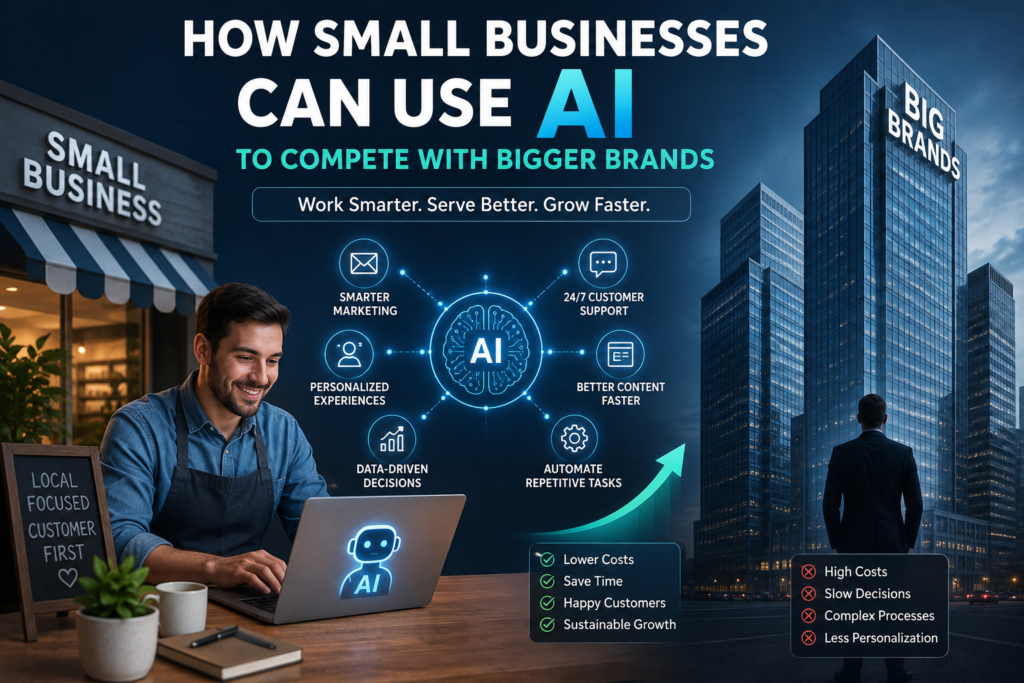
For years, large brands had an obvious advantage over small businesses. They had bigger marketing budgets, larger teams, more customer data, and the resources to invest in expensive technology. Today, artificial intelligence (AI) is changing that equation.
AI is no longer a technology reserved for corporations with huge IT departments. Small businesses can use affordable AI tools to automate repetitive work, create better marketing campaigns, understand customers, improve service, and compete more effectively.
In fact, a 2025 survey of nearly 1,000 small businesses found that 82% believed adopting AI was essential to remaining competitive, while more than half were exploring AI implementation. (National ACE)
The key, however, is not to use AI simply because everyone else is using it. Small businesses should use AI strategically—where it saves time, reduces costs, improves customer experiences, or creates new opportunities.
1. Automate Repetitive Marketing Tasks
Marketing can consume a significant amount of a small business owner’s time. Creating social media posts, writing email campaigns, researching keywords, preparing ad variations, and generating content ideas can take hours every week.
AI can help automate many of these repetitive tasks.
For example, businesses can use AI to brainstorm blog topics, create initial drafts, repurpose long-form content into social posts, develop email subject lines, and generate multiple advertising concepts.
This does not mean publishing everything AI creates without review. Human editing remains essential for accuracy, originality, tone, and brand personality.
The advantage is speed. A small marketing team can produce and test more ideas without needing the resources of a large agency.
2. Deliver More Personalized Customer Experiences
Large brands have traditionally used customer data to personalize recommendations, emails, and promotions. AI is making similar capabilities accessible to smaller companies.
A small online store, for example, can analyze customer behavior and identify popular products, common questions, and purchasing patterns. AI can then help segment customers and create more relevant messages.
Instead of sending one generic email to everyone, a business could create different campaigns for first-time buyers, repeat customers, inactive customers, or customers interested in specific products.
Personalization can make a small company feel more attentive and customer-focused—something that large organizations sometimes struggle to achieve.
3. Improve Customer Service
Customers increasingly expect quick responses, even outside normal business hours. Small businesses may not have enough employees to provide 24/7 support.
AI-powered chatbots and assistants can help answer frequently asked questions, provide basic product information, collect customer details, and direct complex issues to a human employee.
The goal should not be to eliminate human interaction. Instead, AI can handle routine questions while employees focus on conversations requiring judgment, empathy, or expertise.
This can help a small business provide a faster experience without hiring a large support team.
4. Compete With Bigger Brands Through Better Content
Content marketing is another area where AI can reduce the resource gap.
A small business can use AI to research customer questions, identify content opportunities, structure articles, create content briefs, and repurpose existing material.
But there is an important warning: generic AI content is unlikely to create a strong competitive advantage.
Businesses should combine AI efficiency with genuine expertise. Original experiences, case studies, customer stories, expert opinions, demonstrations, and useful local knowledge can make content more valuable and distinctive.
This matters even more as AI-generated answers increasingly influence how consumers discover businesses online. Small businesses need accurate, consistent information across their websites, profiles, reviews, and other public channels because AI systems may use these sources when forming answers about a company. (Business Insider)
5. Use AI for Smarter Decision-Making
Big companies often have dedicated analysts and departments studying business performance. Small businesses can use AI to make their existing data easier to understand.
For example, AI can help analyze sales reports, identify frequently purchased products, summarize customer feedback, find unusual changes in performance, or organize large amounts of business information.
This can help owners move from guessing to making more informed decisions.
The important principle is to use AI as a decision-support tool—not as an unquestioned authority. Business owners should verify important recommendations against reliable data and their own experience.
6. Find and Understand Customers More Efficiently
AI can also make market research more accessible.
Small businesses can use AI to organize customer feedback, identify recurring complaints, analyze competitor positioning, and develop customer personas. This can help answer important questions: Who is the ideal customer? What problems are they trying to solve? What makes them choose one business over another?
The answers can improve everything from product development to advertising.
Rather than trying to appeal to everyone, small businesses can use these insights to dominate a specific niche.
That can be a powerful advantage over bigger competitors.
7. Start Small and Measure the Results
One of the biggest mistakes businesses can make is adopting too many AI tools at once.
Instead, identify one expensive, repetitive, or time-consuming task and test AI there first.
For example:
- Automate frequently asked customer questions.
- Use AI to repurpose existing content.
- Analyze customer reviews.
- Create initial marketing drafts.
- Summarize weekly sales data.
- Automate lead qualification.
Measure the result. Did the process save time? Did it reduce costs? Did it increase leads or conversions? If the answer is yes, expand the workflow.
This practical approach aligns with the broader 2026 SMB trend toward AI applications that are relatively easy to deploy and provide measurable returns. (IDC)
8. Keep the Human Advantage
AI can help small businesses compete, but technology alone is not the competitive advantage.
Small businesses have something many large brands cannot easily replicate: personal relationships.
A local business owner can know customers by name. A specialist can provide highly specific expertise. A small team can respond quickly to changing customer needs.
AI should strengthen these advantages rather than replace them.
The best strategy is therefore AI plus human expertise. Let AI handle repetitive work while people focus on creativity, relationships, strategy, trust, and difficult decisions.
Conclusion
AI is giving small businesses an opportunity to compete based on speed, intelligence, personalization, and execution—not just budget.
A small company does not need to match a large corporation tool for tool. It needs to identify where AI can remove repetitive work, improve customer experiences, strengthen marketing, and support better decisions.
The businesses that benefit most will not necessarily be those using the most AI. They will be the ones using it most intelligently.
Start with one problem. Choose one useful AI application. Measure the results. Then build from there.
The competitive advantage of tomorrow may not belong to the company with the biggest team. It may belong to the small business that knows exactly how to make its team more capable with AI.